Outdoor Temperature
+28°C
City design: 33°C
Cooling Load
500kW
Thermal target: 24°C
Instant PUE
1.21
Silver tier
Energy Saving vs Mech
38%
Current operating point
Annual Temperature Profile & Free Cooling Potential
Monthly average outdoor temperatures with operating mode zones
Full Free Cooling
Partial Free Cooling
Mechanical Cooling
Avg Outdoor Temp
Climate basis: Official ASHRAE 2025 Handbook—Fundamentals, Chapter 14 / ASHRAE Weather Data Center.
The city design dry-bulb references follow the official ASHRAE 2025 framework. The monthly temperature curve shown here is a representative annual simulation layer for rapid free-cooling estimation.
Chiller COP vs Outdoor Temp
Daikin EWAD-C typical performance curve
Monthly Fan Operation
Condenser fan energy (kWh)
Custom Unit Definition
Manually define the chiller model, efficiency metrics and refrigerant data.
Identity & Project Data
kW
kW
°C
°C
Custom unit values can be edited freely. When active, the calculator and exports use these values as the primary device definition.
Seasonal & Part-Load Efficiency
These values shape the custom-unit operating curve and appear in the Excel/PDF reports.
Outdoor Performance Table
Adjust manual outdoor limits and resolution from 1°C to 5°C.
Table Controls
°C
°C
The ambient performance table updates live and is exported to Excel with the active unit data.
Quick Summary
Unit SourceLibrary
Model—
Range-10 to 50
Rows61
The table below shows capacity, compressor power, condenser fan power, total power and effective EER at each ambient point.
| Outdoor Temp | Mode | Capacity | FC Capacity | Compressor | Condenser Fan | Total Power | Effective EER |
|---|
Free Cooling Hours Analysis
Annual breakdown by operating mode for selected city
Monthly Free Cooling Detail
| Month | Avg Temp | Mode | COP | Compressor Power | Fan Power | Total kW | Monthly kWh |
|---|
❄️ Full Free Cooling
T_outdoor ≤ 24°C (thermal target)
CompressorOFF
Condenser Fans100% ON
COP Equivalent15–40+
Power ConsumptionFan only ~3%
Annual Hours—
🌤 Partial Free Cooling
24°C < T_outdoor ≤ 29°C
CompressorReduced Load
Condenser Fans100% ON
COP Range6–9
Savings vs Mech30–60%
Annual Hours—
🔥 Mechanical Cooling
T_outdoor > 29°C
CompressorFULL LOAD
Condenser Fans100% ON
COP at Design—
Peak Power—
Annual Hours—
Annual Operating Hours Distribution
COP vs Outdoor Temperature
Daikin EWAD-C full load curve
Monthly Average COP
Based on city temperature profile
Monthly COP & Power Table
| Month | Avg Temp | COP | Chiller Power (kW) | Fan Power (kW) | Total Power (kW) |
|---|
Current Instant PUE
1.21
Power Usage Effectiveness
PUE = (IT Load + Cooling + UPS Losses + Lighting) ÷ IT Load
IT Load
500 kW
Cooling
82 kW
UPS+Misc
22 kW
Total
604 kW
Monthly PUE Profile
Seasonal variation based on city climate
PUE < 1.4 (Good)
PUE 1.4–1.6 (Acceptable)
PUE > 1.6 (Poor)
—
Annual Energy Saved (kWh)
—
Annual Cost Saved (EUR)
—
CO₂ Avoided (tonnes/yr)
Energy Comparison
Annual kWh: Free Cooling System vs Mechanical Only
Monthly Savings Breakdown
ROI Estimator
System Investment Cost (EUR)
EUR
Estimated Payback Period
— yrs
🏭 Daikin Data Center Free Cooling Portfolio
▼
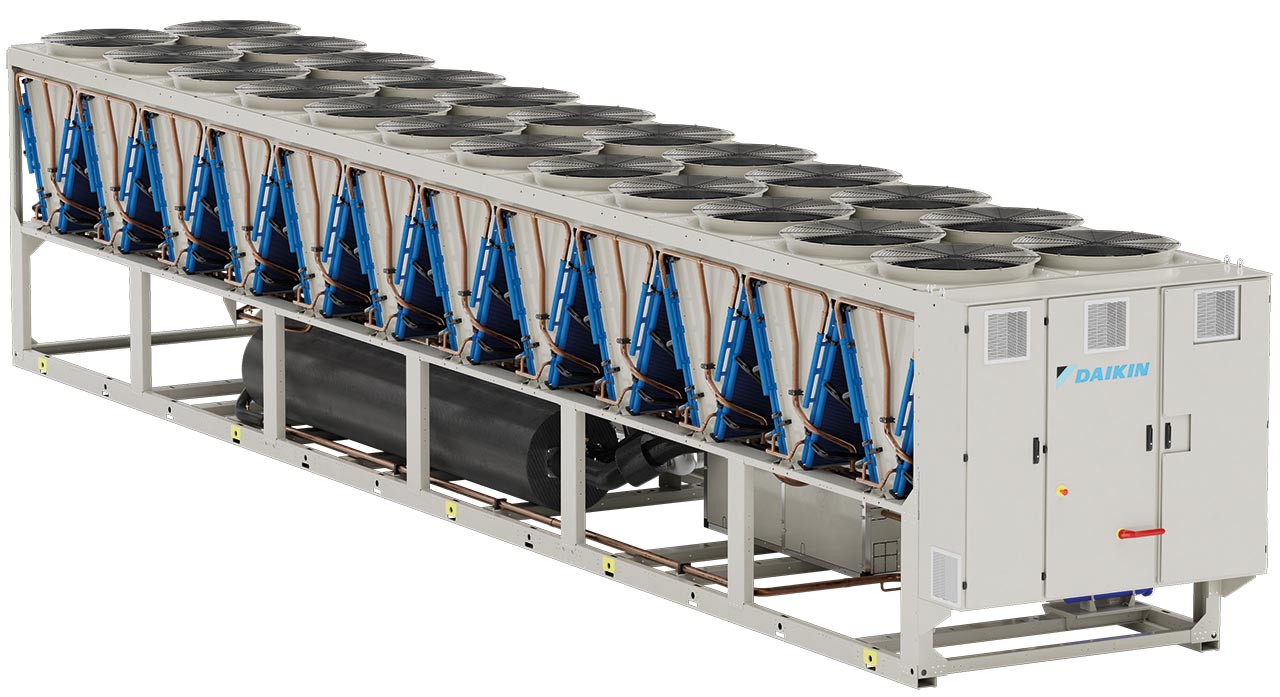
EWFH-TZXSD: Daikin inverter screw free cooling family for large data center duty, with R-1234ze(E), glycol-free application and published nominal capacities up to about 1.8 MW.
EWAD-CFXS / EWAD-CFXR: Air-cooled screw free cooling families with integrated free cooling coils, available in standard-sound and reduced-sound variants for medium-to-large technical cooling loads.
EWAT-B Free Cooling Migration: Compact R-32 scroll alternative with Light and Full migration free cooling, suited to smaller technical rooms, edge sites or support systems.
This app keeps a separate local Daikin model database and uses the selected model as the report reference family.
EWAD-CFXS / EWAD-CFXR: Air-cooled screw free cooling families with integrated free cooling coils, available in standard-sound and reduced-sound variants for medium-to-large technical cooling loads.
EWAT-B Free Cooling Migration: Compact R-32 scroll alternative with Light and Full migration free cooling, suited to smaller technical rooms, edge sites or support systems.
This app keeps a separate local Daikin model database and uses the selected model as the report reference family.
❄️ How Free Cooling Works
▼
Simulation logic in this app: the operating threshold is tied to the selected ASHRAE thermal target instead of a separate approach delta, as requested for this project.
Three Phases:
1. Full Free Cooling: outdoor temperature is at or below the selected target temperature, so compressor operation can be bypassed in the simplified model.
2. Partial Free Cooling: outdoor temperature is above the target but still within the assisted zone, so compressor lift is reduced.
3. Mechanical Cooling: outdoor temperature exceeds the assisted zone and compressors carry the full duty.
Engineering note: real plant design still depends on exchanger geometry, hydronic layout, glycol strategy and factory control logic. This tool is an early-stage comparison simulator.
Three Phases:
1. Full Free Cooling: outdoor temperature is at or below the selected target temperature, so compressor operation can be bypassed in the simplified model.
2. Partial Free Cooling: outdoor temperature is above the target but still within the assisted zone, so compressor lift is reduced.
3. Mechanical Cooling: outdoor temperature exceeds the assisted zone and compressors carry the full duty.
Engineering note: real plant design still depends on exchanger geometry, hydronic layout, glycol strategy and factory control logic. This tool is an early-stage comparison simulator.
📊 ASHRAE 2025 Climate Data
▼
Official source reference: ASHRAE Handbook—Fundamentals 2025, Chapter 14, together with the ASHRAE Weather Data Center.
0.4% Design Condition: The outdoor temperature is exceeded only 0.4% of annual hours (~35 hours/year). This is the standard design temperature for mechanical cooling systems — sized to handle all but the most extreme conditions.
How this app uses it: city design dry-bulb references are positioned as an official ASHRAE 2025 climate basis. The annual chart and energy logic still use representative monthly averages for fast project-stage simulation; hourly weather files would be the next step for detailed design validation.
0.4% Design Condition: The outdoor temperature is exceeded only 0.4% of annual hours (~35 hours/year). This is the standard design temperature for mechanical cooling systems — sized to handle all but the most extreme conditions.
How this app uses it: city design dry-bulb references are positioned as an official ASHRAE 2025 climate basis. The annual chart and energy logic still use representative monthly averages for fast project-stage simulation; hourly weather files would be the next step for detailed design validation.
🌡️ ASHRAE Thermal Classes
▼
A1: 18–27°C, mission critical envelope.
A2: 10–35°C, standard data center envelope.
A3: 5–40°C, less controlled envelope.
A4: 5–45°C, minimal control envelope.
In this interface the thermal class constrains the target cooling temperature slider, and manual mode opens a custom operating envelope when the project needs a non-standard range.
A2: 10–35°C, standard data center envelope.
A3: 5–40°C, less controlled envelope.
A4: 5–45°C, minimal control envelope.
In this interface the thermal class constrains the target cooling temperature slider, and manual mode opens a custom operating envelope when the project needs a non-standard range.
🗂️ Local Chiller Database
▼
A separate local data file is included in
The file stores model family, compressor type, refrigerant, nominal capacity range, free cooling description and source URL fields so the app can be expanded later without rewriting the calculator logic.
assets/data/daikin-free-cooling-chillers.js.The file stores model family, compressor type, refrigerant, nominal capacity range, free cooling description and source URL fields so the app can be expanded later without rewriting the calculator logic.
📈 PUE — Power Usage Effectiveness
▼
Definition (The Green Grid): PUE = Total Facility Power ÷ IT Equipment Power
Ratings:
• PUE < 1.2 → Platinum (Ultra-Efficient, e.g. hyperscale)
• 1.2–1.4 → Gold (Excellent — target for modern data centers)
• 1.4–1.6 → Silver (Acceptable — typical legacy facility)
• > 1.6 → Bronze (Poor — significant improvement needed)
Free cooling reduces mechanical cooling power by 30–70% in favorable climates, directly reducing PUE. A facility in a cool-climate city like Stockholm or Warsaw may achieve annual average PUE of 1.15–1.25 with a free cooling chiller system.
Ratings:
• PUE < 1.2 → Platinum (Ultra-Efficient, e.g. hyperscale)
• 1.2–1.4 → Gold (Excellent — target for modern data centers)
• 1.4–1.6 → Silver (Acceptable — typical legacy facility)
• > 1.6 → Bronze (Poor — significant improvement needed)
Free cooling reduces mechanical cooling power by 30–70% in favorable climates, directly reducing PUE. A facility in a cool-climate city like Stockholm or Warsaw may achieve annual average PUE of 1.15–1.25 with a free cooling chiller system.
📖 Glossary
▼
COP — Coefficient of Performance: Cooling capacity ÷ Power input. Higher = more efficient.
EER — Energy Efficiency Ratio: COP × 3.412 (BTU/h/W). US rating standard.
ESEER — European Seasonal EER: Weighted average at 100/75/50/25% load conditions.
PUE — Power Usage Effectiveness: Total power ÷ IT power.
Free Cooling — Using outdoor cold air (directly or via refrigerant circuit) to cool without compressor.
Thermal Envelope — Allowed operating band selected from ASHRAE A1–A4 or defined manually.
Dry Bulb Temp — Standard air temperature measured in shade with dry thermometer.
ASHRAE — American Society of Heating, Refrigerating and Air-Conditioning Engineers.
Thermosiphon — Natural refrigerant circulation by gravity/buoyancy without pump/compressor.
EER — Energy Efficiency Ratio: COP × 3.412 (BTU/h/W). US rating standard.
ESEER — European Seasonal EER: Weighted average at 100/75/50/25% load conditions.
PUE — Power Usage Effectiveness: Total power ÷ IT power.
Free Cooling — Using outdoor cold air (directly or via refrigerant circuit) to cool without compressor.
Thermal Envelope — Allowed operating band selected from ASHRAE A1–A4 or defined manually.
Dry Bulb Temp — Standard air temperature measured in shade with dry thermometer.
ASHRAE — American Society of Heating, Refrigerating and Air-Conditioning Engineers.
Thermosiphon — Natural refrigerant circulation by gravity/buoyancy without pump/compressor.